Execution Autonomy: Humans direct, AI executes. Humans decide what to improve and how to improve it; the AI simply carries out the prescribed updates or code execution.
Strategy Autonomy: AI chooses the approach. The AI selects its own improvement tactics, algorithms, or architectures to achieve human-defined optimization targets.
Experience-Acquisition Autonomy: AI generates its own training data. The AI autonomously determines what new data, synthetic experience, or evaluation benchmarks it needs to progress.
Environment-Adaptation Autonomy: AI adapts in deployment. The AI continuously updates and refines its state based on real-world feedback and environment interactions.
Meta-Improvement Autonomy: AI improves the improver. The AI modifies and upgrades the underlying mechanisms that generate future improvements, starting a true recursive flywheel.
Efficiency: using a harness improves cost per task and increases speed
Infra: running the agent in the cloud
Permission: approval mechanism (automatic/manual) and guardrails (e.g. cost)
Jediah is insightful with deep experience. If you have time, I highly recommend watching the video. It has nice diagrams and helps understand the harness, as a tool that we increasingly depend on.
Idea: The author spent $50 to generate 50,000 synthetic statistical pages (fake data) which was in turn picked up by AI agents as facts!
Results:
Google quickly deindexed the site
Other LLM providers like ChatGPT continued to rely on the fake data in response to user queries (72k req/m)
10k referral sessions from 330+ domains!
Real-time search agents prioritize latency over fact-checking and grounding
My take: Google’s immediate response shows their search expertise. But I’m also a bit surprised that ChatGPT is so vulnerable. In the “out of scope” section I mention that DeepSeek recently offered a search API.
What? Anthropic’s leaked proposed bill for AI regulations that lets the government block a model’s release ONLY if it poses a foreseeable and imminent risk up to that threshold.
Problem: they set the threshold very high! Are 50 lives or $1B really an acceptable price for AI advancement?
Key takeaways:
It’s not a law. Just a suggestion by a company. The actual text is pay-walled so I couldn’t read it.
Anthropic lobbyists have already started discussing tweaks to the draft in response to the leak
These thresholds are for pre-release assessments (can the model cause that much harm?) not incident assessment (did the model cause this much harm?) by independent evaluators who then have 72h to report the risk.
The threshold is per vulnerability, meaning if 2 hypothetical issues can cause 40 deaths each, the model is not blocked! 😯 Guess that’s an acceptable sacrifice for curing cancer, solving diseases, eliminating poverty or whatever we’re promised!
My take: if the threshold equates the risk of 50 lives to $1B, is each life worth $20M?
Idea: use a lightweight residual adapter (HybridLink) to map last-layer hidden states back into the input embedding space. This creates recurrent latent thinking without discrete text tokens. It requires a 2-stage training. Here’s a YouTube short by Parth covering it.
Advantage: faster inference, cost saving, token reduction and more accuracy.
Risk: one of the advantages of the current CoT (chain of thought) reasoning method is that we can verify the model’s thought. This approach doesn’t hides those tokens.
Mitigation: This approach mitigates part of that problem by mapping latent representations back to pseudo-text for debugging and auditability. It’s not perfect because sometimes you end up with illegible text.
My take: the advantages are too good and the only drawback I could think of is addressed. We’ll see if models start to use this architecture soon.
If you found this issue insightful, please share it in your circles and on social media to inspire others and help its growth
These are some links that didn’t make it to the top-5 due to my strict criteria and promise to you. If you have time, have a look:
The bold text marks the things I was involved with.
2026-10-29: I partnered with AI Champions, a free remote conference covering long-running AI agents, AI pilots that stick, AI adoption across a large organisation, measuring the impact of AI training, etc. (this is not a paid ad)
2026-10-21: Calling data centers “meat smoothies” is dark humor! (YouTube short, 140 seconds)
2026-10-20: Sofia Liguori left her lucrative job at Google DeepMind due to military contracts and ethical concerns: “we have a responsibility to assess the tool in the context in which it's going to be used.”
2026-10-19: I wrote the rise and fall of Jev to diagnose how name-dropping, strategic ambiguity, and big claims are systematically used to hype AI marketing
2026-10-05: Predicting the future of AI automation. TL;DW: there’ll be a massive surge of interest in AI automation specialists. Disclaimer: he sells courses on the topic, so keep that in mind (YouTube, 24 minutes)
2026-10-04: Tristan Harris argues the only way AI labs will be able to pay back their debt is to replace a large part of the workforce (YouTube short, 90 seconds)
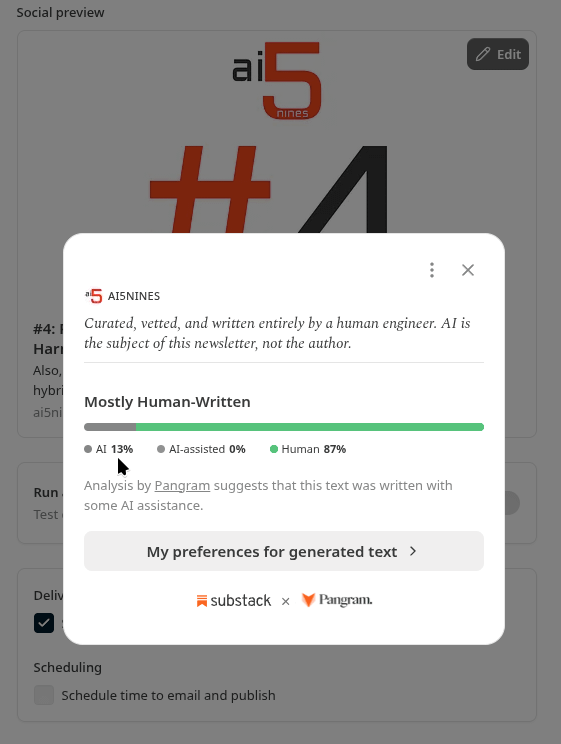
When sending an issue, substack has a button that allows checking if it’s AI generated! To my surprise it says 13% of this post is AI generated. 🤔 And here I am, after spending 4 hours looking at the screen like “WTF?”
A question for you:
Now that you’ve seen the 4th issue, is there something you particularly like about this newsletter? Is there something that could improve? Please give me some feedback.